


For commuters in cities like Zurich, Basel, and Lausanne, driving is no longer the effortless solution it once seemed to be. Fuel prices continue to rise, congestion has become part of everyday life, and finding parking in city centers often feels more stressful than the journey itself.
What used to be a simple 20-minute commute can easily become 45 minutes of traffic lights, slow-moving queues, and unnecessary monthly expenses.
That is exactly why electric scooters are no longer viewed as a niche gadget or a “last-mile” trend. In Switzerland’s increasingly crowded urban environments, they are becoming a realistic, efficient, and financially smarter alternative for daily commuting.
Not because they replace cars completely - but because, for many city journeys, they simply make more sense.
THE REAL COST OF DRIVING IN SWITZERLAND
Most drivers underestimate how expensive daily commuting actually is.
The monthly cost of owning a car in Switzerland goes far beyond fuel alone. Once parking, insurance, maintenance, servicing, depreciation, and urban traffic are added into the equation, the numbers become difficult to ignore.
In cities like Zurich, a private parking space alone often costs between CHF 150 and CHF 350 per month depending on location.
Fuel prices and charging costs also remain significantly higher than they were only a few years ago, especially for commuters driving daily through urban areas.
By comparison, an electric scooter consumes only a fraction of that energy.
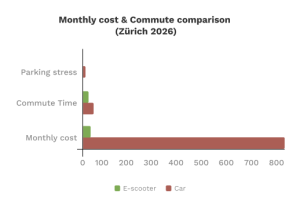
For a typical commuter riding 10-15 km daily, charging an electric scooter often costs less than CHF 2-5 per month in electricity.
MONTHLY COMMUTING COST: CAR VS ELECTRIC SCOOTER
Swiss residential electricity prices average around CHF 0.30-0.32/kWh.
Most electric scooters use roughly 0.5-1.5 kWh for a full charge depending on battery size. Even frequent riders typically spend only a few francs per month on electricity.
Over the course of a year, the financial difference becomes substantial.
TIME MATTERS MORE THAN EVER
Money is only part of the equation.
For many commuters, the bigger issue is time.
Urban traffic in Switzerland has become increasingly unpredictable, especially during peak morning and evening hours. A route that should take 20 minutes can easily stretch to 40 minutes or more during congestion.
Electric scooters fundamentally change that experience.
Instead of sitting inside traffic:
- you keep moving,
- you avoid queues,
- you eliminate parking delays,
- and you regain consistency in your daily schedule.
For distances up to 5-10 km, scooters often outperform cars in real-world city conditions.
And perhaps more importantly: the commute itself becomes calmer.
A DIFFERENT KIND OF MORNING
It is 7:30 on a summer morning in Zurich.
You leave your apartment already thinking about traffic. You know the usual routine: crowded intersections, slow-moving traffic near the city center, rising fuel costs, and the constant uncertainty of whether you will even find parking near your office.
You stop at one traffic light.
Then another.
Then another.
You glance at the clock repeatedly.
By the time you arrive, the day has already started with frustration.
Now imagine the same morning differently.
The streets are still busy, but instead of being trapped inside traffic, you move through the city smoothly and without interruption. There is no search for parking. No waiting in queues. No concern about fuel consumption or parking fees ticking upward every hour.
You arrive quietly, on time, and with far less stress.
That daily difference is one of the main reasons electric scooters are becoming increasingly common across Swiss cities.
Not because they are trendy - but because they simplify everyday life.
WHY ELECTRIC SCOOTERS FEEL MORE PRACTICAL IN CITIES
Cars remain essential for long-distance travel, family transport, winter mountain trips, and many professional needs.
But urban commuting is a different category entirely.
For short-to-medium city distances, e-scooters offer several advantages that become noticeable very quickly:
- Immediate departure without traffic delays
- Easy parking almost anywhere
- Lower operating costs
- Faster movement through dense urban areas
- Easier integration with public transport
- Less stress during peak hours
For commuters combining trains, trams, and shorter city journeys, electric scooters also solve the “last kilometer” problem exceptionally well.
Instead of waiting for connecting buses or walking long distances from parking garages, riders can complete short urban routes quickly and efficiently.
CHOOSING THE RIGHT ELECTRIC SCOOTER
Not every rider needs extreme speed or oversized batteries.
The best e-scooters depends on how and where it will actually be used.
For Short Daily Urban Commutes
These models focus on portability, simplicity, and practicality for city riding:
Ideal for compact city travel, mixed train + e-scooter commuting, and apartment living.
For Longer Daily Distances
These e-scooters offer stronger battery capacity and more comfort for regular commuting:
Ideal for 10-25 km daily commutes and riders prioritizing battery range and ride stability.
For Premium Performance & Comfort
For riders wanting maximum comfort, suspension quality, and stronger acceleration:
These models are designed for longer urban routes, stronger ride comfort, and demanding daily riders.
LOWER MAINTENANCE COSTS MAKE A BIG DIFFERENCE
Another overlooked advantage of electric scooters is mechanical simplicity.
Cars require:
- oil changes,
- inspections,
- expensive servicing,
- tire replacements,
- and occasional unexpected repairs.
E-scooters are significantly simpler to maintain.
In most cases, regular ownership costs are limited to:
- tire maintenance,
- brake adjustments,
- occasional battery care,
- and general inspections.
For many commuters, this predictability becomes one of the biggest long-term advantages.
WHAT ABOUT THEFT AND INSURANCE?
One of the most common concerns people have before buying an electric scooter is theft.
Fortunately, this problem can also be solved.
Today, several providers in Switzerland offer insurance specifically designed for electric scooters, giving riders additional peace of mind when commuting daily or parking in urban areas.
You can learn more here:
For many commuters, this makes the transition from car to e-scooter feel significantly safer and more practical.
THE LEGAL REALITY IN SWITZERLAND
Electric scooters are practical, but they are not completely unrestricted.
In Switzerland, road-legal e-scooters must comply with specific regulations regarding maximum speed, lighting, braking systems, and road approval requirements.
Generally:
- e-scooters approved for Swiss roads are limited to 20 km/h,
- riders must use bike lanes where applicable,
- and proper front/rear lighting is mandatory.
Helmet use is strongly recommended, even when not legally required for lower-speed models.
It is also important to be realistic about weather conditions.
Electric scooters are excellent for urban commuting during most of the year, but they are less practical during:
- heavy rain,
- snow,
- icy winter conditions,
- or very long-distance travel.
For many people, the ideal solution is not “car OR e-scooter.”
It is a smarter combination of public transport, occasional car use, and electric scooter commuting for daily city movement.
WHY THIS SHIFT IS HAPPENING NOW
Several factors are pushing urban commuters toward alternative forms of transportation, including rising fuel costs, expensive city parking, and increasing traffic congestion in major urban areas. At the same time, growing environmental awareness and the increasing pressure placed on urban infrastructure are encouraging both individuals and cities to look for more efficient, sustainable, and flexible mobility solutions.
At the same time, electric scooters have improved dramatically in recent years.
Modern models now offer:
- better battery range,
- stronger reliability,
- improved ride comfort,
- and far more refined build quality than earlier generations.
As a result, e-scooters are no longer viewed as temporary gadgets.
They are becoming a legitimate part of modern urban transport.
CONCLUSION: A SMARTER WAY TO MOVE THROUGH THE CITY
Switching from a car to an electric scooter is not simply about saving money.
It is about improving the quality of everyday life.
Less time in traffic.
Less money spent on commuting.
Less stress at the beginning and end of the day.
Cars will always remain important for certain journeys. But for urban commuting in modern Swiss cities, they are increasingly no longer the most efficient solution.
That is why more commuters are beginning to rethink how they move through the city - and why electric scooters are becoming part of that future.